





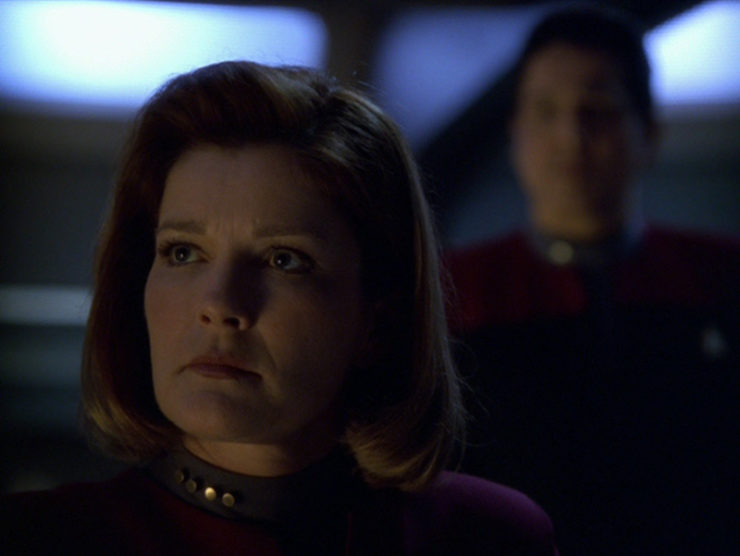
Star Trek: Voyager Fifth Season
Original air dates: October 1998 – May 1999
Executive Producers: Rick Berman, Brannon Braga
Captain’s log. Of all the seasons of Voyager to date, the fifth was the one that had the most literal forward motion. Thanks to a wormhole of sorts (“Night”), experiments with the quantum slipstream drive (“Timeless”), and a stolen Borg transwarp conduit (“Dark Frontier”), they made several jumps ahead, cutting their journey home by tens of thousands of light-years.
We got a new recurring antagonist in the environmentally impure Malons (“Night,” “Extreme Risk,” “Juggernaut”), and two old recurring antagonists, as the Borg are still a problem (“Drone,” “Dark Frontier”), as are Species 8472 (“In the Flesh”), though our heroes reach a rapprochement with both 8472 and the Malon.
Some of the ship’s past missions are actually referenced again. The quantum slipstream drive from “Hope and Fear” is tested in “Timeless,” the crew’s ill-advised alliance with the Borg against 8472 comes back to bite them in both “In the Flesh” and “Dark Frontier,” and we look in on the duplicate crew from the “Demon” planet in “Course: Oblivion.” Both Janeway and Torres deal with depression, the former for the crew’s being stranded in general in “Night,” the latter from learning in “Hunters” of the massacre of the Maquis in “Extreme Risk.” And the animus several crewmembers have against the Cardassian Union rears its ugly head in “Nothing Human.”
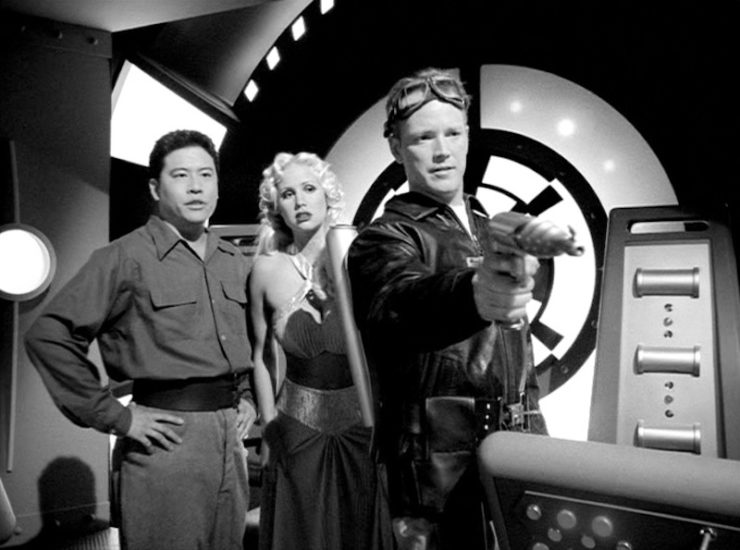
The Torres-Paris relationship continues apace, surviving not just Torres’s depression, but Paris’s being imprisoned for a month (“Thirty Days“) and being stranded on a planet for a while (“Gravity”). Paris also gives us the best of the recurring holodeck programs in Captain Proton (“Night,” “Thirty Days,” “Bride of Chaotica!”), which will continue to appear until the end of the show.
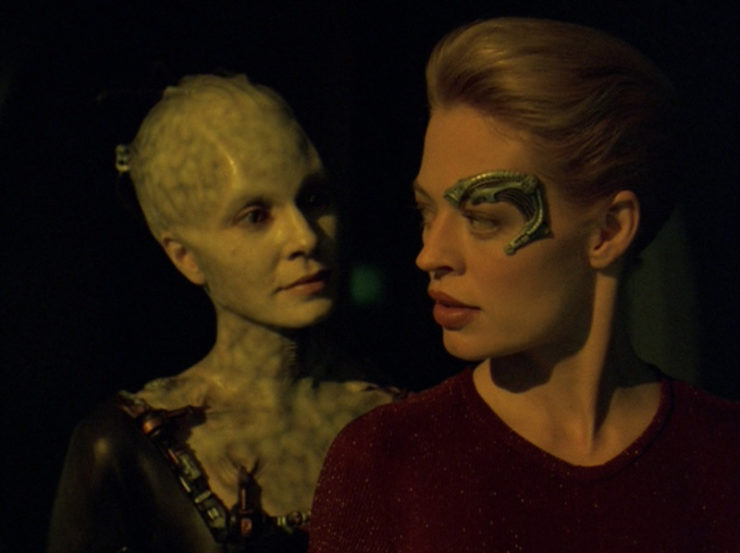
Naomi Wildman gets over her fear of Seven to become a protégé of the ex-Borg, and she aspires to become the captain’s assistant. Seven’s growth continues, guided mainly by the EMH, who also finds himself falling in love with her (“Someone to Watch Over Me”).
And our crew encounters all manner of Delta Quadrant species, some friendly (“Thirty Days”), some not so much (“Counterpoint”), some that are sort of in the middle (“The Disease”). Plus we get two wacky time-travel adventures (“Timeless,” “Relativity”).
While there are no direct links to the Alpha Quadrant, there are indirect ones, from the alternate timeline of “Timeless” to the re-creation of Starfleet Headquarters in “In the Flesh” to the flashbacks to the year 2000 in “11:59” to the re-creation of a Cardassian scientist in “Nothing Human.”
Highest-rated episode: “Bride of Chaotica!” with a 10. Honorable mention to the season’s six 9s: “Night,” “Drone,” “Latent Image,” “Gravity,” “Course: Oblivion,” and “Warhead.”
Lowest-rated episode: “Dark Frontier” with a 2, a disastrous reunion with the Borg that came pretty close to singlehandedly ruining one of Trek’s greatest villains.
Most comments (as of this writing): “Latent Image” with 103, and it’s not even a contest. The only episode this season to break three figures in comments, it’s also only one of three to have more than 60 comments (“Bride of Chaotica!” and “Equinox” both reached 70).
Fewest comments (as of this writing): “Counterpoint” with only 24, and it’s fascinating to me how many times in my various rewatches this “winner” has been a good, solid episode like this one.
Favorite Can’t we just reverse the polarity? From “Relativity”: Ducane quizzes Seven on temporal theory, including the Pogo Paradox and the Dali Paradox. Seven describes the former as, “A causality loop in which interference to prevent an event actually triggers the same event,” which means it’s named for the famous line from the title character in Walt Kelly’s comic strip Pogo, “We have met the enemy and he is us.” The Dali one is based on Salvador Dali’s Persistence of Memory, the one with all the melting clocks, and is when a temporal fissue slows time down to a crawl.
Favorite There’s coffee in that nebula!: From “Warhead”: After the attempt to sabotage the warhead fails, the AI instructs Janeway to abandon ship. She refuses. The AI points out that it will destroy the ship, and Janeway very calmly tells him to go ahead. When the AI counters that everyone on the ship will die, Janeway, still very calm, says that yes, but nobody else will. It’s quite the captainly moment.
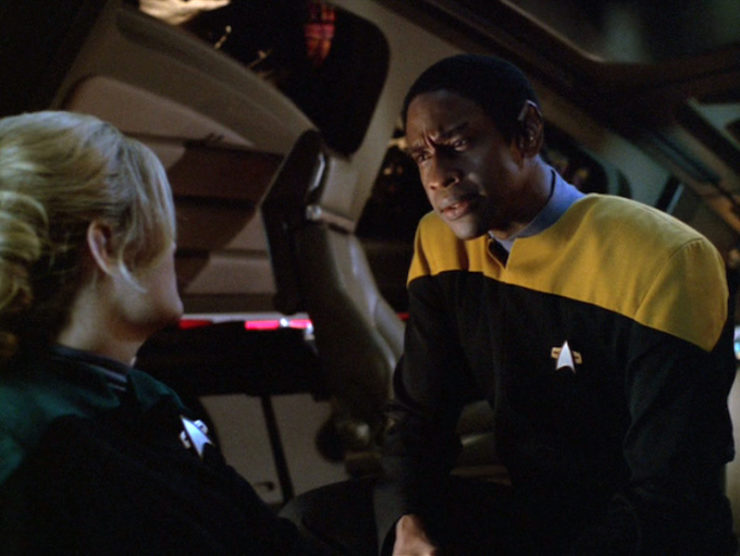
Favorite Mr. Vulcan: From “Once Upon a Time”: Tuvok does a magnificent job of reassuring Wildman that Naomi will be okay even if she doesn’t make it. He says: “My youngest child has been without a father for four years, yet I am certain of her well being, that I conveyed my values to her before leaving. And I have confidence in the integrity of those around her. You have been an exemplary mother to Naomi, and she is in the hands of people you trust. She will survive and prosper, no matter what becomes of us.” Just another reminder that Tuvok is a fantastic parent and is generally totally awesome.
Favorite Half and half: From “Extreme Risk”: Torres’ normal state is to be angry, so when given news that would normally make someone angry, she instead becomes numb. Her constant attempts to harm herself are a desperate attempt to feel something, and she’s healing her physical injuries herself (badly) to avoid it being reported by the EMH in sickbay.
Favorite Forever an ensign: From “Someone to Watch Over Me”: Kim is greatly enthusiastic at the notion of Seven dating until she informs him that he’s not on her list of finalists, at which point you can see his crest fall. However, he gamely kibbitzes on her choices, pointing out that Ensign Bronowski does like music, but he also plays the accordion really badly and also has no sense of humor, leading Seven to cut him from the list.
Favorite Everybody comes to Neelix’s: From “Night”: Neelix’s suggestion for a way to alleviate the boredom is for the crew to cross-train in areas of the ship they’re less familiar with. A ship that’s lost so many of its crew and had to integrate a bunch of terrorists should have cross-discipline training as a matter of course, so it’s weird that that hasn’t happened in four years. Then again, Neelix may have just been suggesting it by way of he himself getting more training, consistent with his endless desire to make himself more useful to the crew.
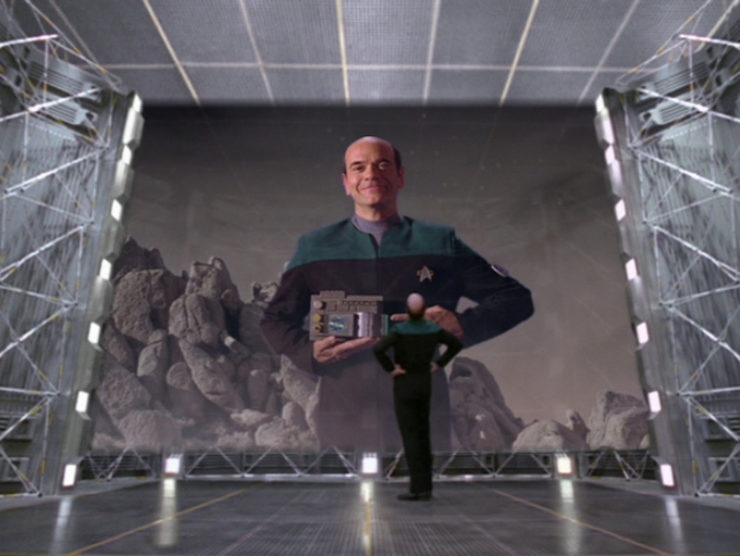
Favorite Please state the nature of the medical emergency: From “Nothing Human”: The EMH has been showing slideshows to the crew. Chakotay and Kim sat through one showing, and Janeway requested that, when it was time for her, Tuvok, Paris, and Torres to watch it, Chakotay should call for some kind of alert partway through. Chakotay neglects to do so, as he feels his fellow crewmates should enjoy every excruciating nanosecond of the EMH’s stultifying presentation, just as he did.
Favorite Resistance is futile. From “11:59”: Seven mentions an ancestor of her own that she’s found: Sven “Buttercup” Hansen, a prize fighter. She is skeptical as to Neelix’s claims that there is significance to her being a descendant of his. (Neelix’s mentioning of the similarity between the names Sven and Seven is met with a Stare Of Dubiousness.)
Favorite What happens on the holodeck, stays on the holodeck: From “Extreme Risk”: I’ve said it before and I’ll say it again: WHY DOES THE HOLODECK HAVE SAFETIES THAT CAN BE DISENGAGED?????? WHY AREN’T THE SAFETIES FUCKING HARDWIRED?????????????
Favorite No sex, please, we’re Starfleet: From “The Disease”: So you know how some people are described as glowing after they’ve had really good sex? The Varro literally glow after sex. Which, if nothing else, makes it hard to be discreet about the fact that you’re having sex…
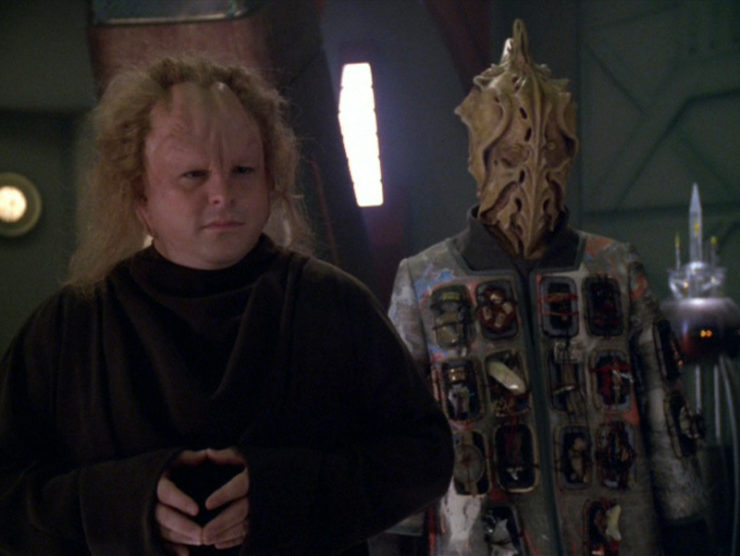
Favorite Welcome aboard: One of the most impressive collections of guest stars you’re likely to see in this particular season.
We’ve got Steve Dennis playing four different characters in “Night,” “Think Tank,” “Warhead,” and “Equinox.” We’ve got fine performances by David Clennon (“Nothing Human“), Alissa & Heidi Kramer (“Thirty Days”), Mark Harelik (“Counterpoint”), Nancy Bell (“Latent Image”), and Olivia Birkelund (“Equinox”).
We’ve got two new recurring regulars in Martin Rayner as the holographic Doctor Chaotica and Scarlett Pomers taking over the role of Naomi Wildman, plus back for more are Alexander Enberg as Vorik, Ray Walston as Boothby (kind of), Nancy Hower as Wildman, and Josh Clark as Carey.
We’ve got Trek regulars J. Paul Boehmer (“Drone”), Hamilton Camp (“Extreme Risk”), J. Patrick McCormack, Randy Oglesby (“Counterpoint”), Nicholas Worth (“Bride of Chaotica!”), Joseph Ruskin (“Gravity”), W. Morgan Sheppard (“Bliss”), Susanna Thompson (“Dark Frontier”), Ned Romero (“The Fight”), Christopher Shea, Christopher Darga (“Think Tank”), Ron Canada, Lee Arenberg (“Juggernaut”), McKenzie Westmore (“Warhead”), and Rick Worthy (“Equinox“), not to mention LeVar Burton reprising the role of La Forge (“Timeless”).
We’ve got some great actors showing up on Trek for the first time, including Kate Vernon, Zach Galligan (“In the Flesh”), Wallace Langham (“Once Upon a Time”), Willie Garson (“Thirty Days”), Lori Petty (“Gravity”), Charles Rocket, Musetta Vander (“The Disease”), Ian Abercrombie, David Burke, Scott Thompson (“Someone to Watch Over Me”), John Carroll Lynch, Kevin Tighe (“11:59”), Bruce McGill, Jay Karnes, Dakin Matthews (“Relativity”), John Savage, and Titus Welliver (“Equinox”).
But the big guest of the year is Jason Alexander, at the time very much playing against his George Costanza type as Kurros in “Think Tank.”
Favorite Do it: From “Someone to Watch Over Me”:
“‘Stardate 52647, 1400 hours: Subjects quarrel in corridor outside female’s quarters. Male returns with twelve flowering plant stems, species rosa rubifolia, effecting a cessation of hostilities. Stardate 52648, 0300 hours: Intimate relations resume.’ How the hell do you know when we’re having intimate relations?”
“There is no one on deck nine, section twelve who doesn’t know when you’re having intimate relations.”
–Torres angrily reading Seven’s account of Paris and Torres’s relationship, and Seven saying “Bazinga!”
Favorite Trivial matter: The one from “Night” because I got to mention all the other uses of Captain Proton in the tie-in fiction.
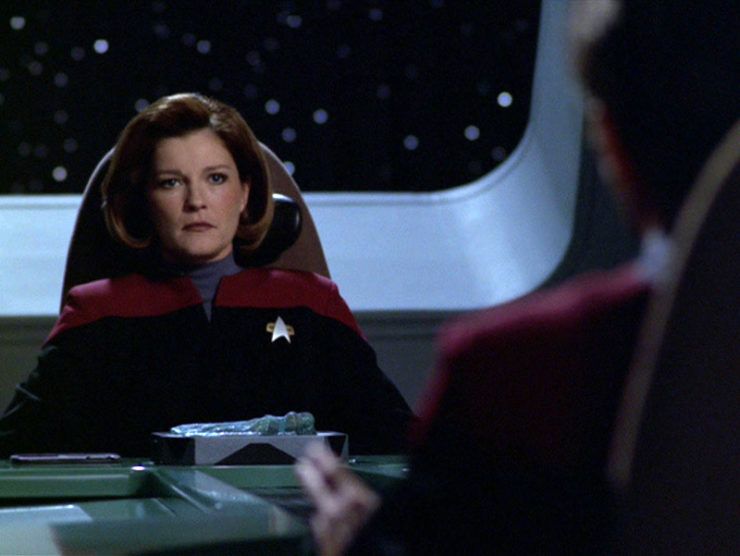
Set a course for home. “Perhaps you weren’t paying attention when the Malon freighter imploded.” I once got a second-hand account from a couple of freelance screenwriters who were pitching to Voyager, who were told by the producer to whom they were pitching: “You keep giving us stories—we’re looking for ideas.” After watching the fifth season, I can see how that rather idiotic philosophy suffused the production of the show, because there are a lot of ideas here, often very much at the expense of story.
It seems like the approach this year was to just come up with high concept after high concept, and then belatedly tried to figure out how it would fit in the show, regardless of whether it actually did or not. Or whether or not the story made anything like sense.
Sometimes this worked. There are some truly excellent episodes this season, from the delightfully self-aware goofiness of “Bride of Chaotica!” to Tuvok and Noss’ doomed love affair in “Gravity” to the tragedy of “Course: Oblivion.” Several episodes do superb work in showing the psychological effects of Voyager’s journey: Janeway’s clinical depression in “Night,” Torres’ grief-induced self-harming in “Extreme Risk,” Seven’s developing humanity in “Drone” and “Someone to Watch Over Me,” and the EMH’s existential crisis in “Latent Image.” Plus, of course, there’s the there-but-for-the-grace-of-God look at the Equinox crew in their eponymous season finale.
And sometimes it didn’t. “In the Flesh,” “Nothing Human,” “Dark Frontier,” “The Disease,” “Think Tank,” “The Fight,” and “11:59” are all concepts that could have worked, but really really really really didn’t.
It also feels like Janeway is marginalized, which is a bad look for the first season in which a woman isn’t the show-runner. The episodes where Kate Mulgrew does get a lot to do are few and far between, and in many of them she’s not even playing Janeway herself, whether figuratively (“Night” where she’s depressed, “Course: Oblivion” where she’s a duplicate), literally (“11:59,” where she plays her own ancestor), or deliberately (“Bride of Chaotica!” where she cosplays as Arachnia). Having said that, both Torres and especially Seven get a lot to do, as does the EMH, with Chakotay, Paris, Kim, Tuvok, and Neelix all getting a moment or three in the sun, and while they’re not always successful—in particular the attempts at developing Kim are mostly disastrous—at least they’re giving folks a shot.
Having said that, the show was what it was at this point, and it’s to this season’s credit that most of it is at least good, and some of it is great. Comparatively little of it is outright bad, and only “Dark Frontier” is truly wretched. Even if they can’t settle on how many people are on board or remember character development from one episode to the next or give the non-opening-credits regulars anything to do ever unless they’re a cute kid.
Warp factor rating for the season: 6
Keith R.A. DeCandido’s most recent novels are collaborations: To Hell and Regroup with David Sherman and Animal with Dr. Munish K. Batra. His most recent short stories include “In Earth and Sky and Sea Strange Things There Be” in Turning the Tied and “Unguarded” in the forthcoming anthology Devilish and Divine.


When I pitched a set of largely plot-driven episode proposals for Deep Space Nine, the idea that got drilled into my head was that the most important thing was how the stories affected the characters. So I developed a bunch of character-driven proposals for my first Voyager pitch, and was told that they wanted plot-driven high-concept ideas instead. I once saw a quote from another pitcher who described having the exact same experience.
Season 5 of Voyager is probably one of the most remembered seasons for me simply due to the fact that Star Trek: The Magazine was just newly introduced and as a 13/14 year old bought a few during that time (which was pricey at about $8.00 a magazine back in 1999) and they had a pretty good overview of the fifth season with looks at “Someone to Watch Over Me” and “Gravity” (and I’m sure a few others that escape me for a moment). As well, this was also at a point where the cinematography took a turn for the better and got even better the next season as well, but season 5 has a very distinct look.
The flashback to when Janeway was walking the ship for the first time made me realize how much I miss the bun. Count me as a bun fan.
Neelix seemed to be largely a background character this season, with just a few exceptions.
Many regulars only had a scene or two in a good amount of episodes. That always made me wonder: does that mean the actor only has to work one day for that episode? Not sure if they have any responsibilities outside of filming. Rehearsal days maybe?
This season made it clear that it is the Janeway, Doctor, and Seven show from now on.
Many regulars only had a scene or two in a good amount of episodes. That always made me wonder: does that mean the actor only has to work one day for that episode? Not sure if they have any responsibilities outside of filming. Rehearsal days maybe?
Several of them also had non-Trek supporting roles on the side.
And it wasn’t limited only to VOY. Armin Shimmerman, for instance, was playing Principal Snyder on Buffy in-between shooting days on DS9.
That’s a good way to differentiate season 5 from season 4. Swinging for big ideas. Otherwise, I find season 5 to be rather similar to 4.
But for all intents and purposes, this was the season that represented peak Voyager. Brannon Braga was fresh as head writer and put some real effort to make it good. There were a few clunkers as usual, but overall it didn’t have the slump that the latter third of season 4 had, and it didn’t have any atrocious stinkers either. Plus, the quality of the top tier episodes was up there with the best of any Berman-era show: Drone; Gravity; Chaotica; Latent Image. A winning streak of memorable episodes. Darmok and Inner Light aside, I could easily place this season of Voyager alongside TNG’s own fifth season in terms of quality. Solid character work as always, and some great guest casting top it off.
Stil, this plot-driven high concept approach still has its drawbacks, and we’ll see that downfall in season 6, which is when the show takes a steep dive in quality (though there are still a couple of superb shows there). The danger of being fully plot driven is you start running out of fresh ideas. Either you start recycling, or you attempt to do more outrageous concepts (in Voyager’s case, capitulate to the WMF crowd, or do Fair Haven). Of course, it can also happen to character based shows. TNG’s own final season had its own dearth of ideas and resorted to never before seen relatives of main characters to keep the machine going.
“WWF crowd”.
This is the last time I type on a phone.
Krad: “Relativity” also broke more than 60 comments (it’s at 71 comments as of this writing).
In regards to solid, well-done episodes getting consistently the lowest comments every season, I think it’s not so much there is disagreement with us commenters about the quality, but that there isn’t a whole lot to pick apart if the particular episode isn’t truly amazing, truly horrible, or controversial or ground-breaking in some way. For instance, why I agree “Counterpoint” is a solid outing, it’s not going to elicit the kind of analysis and debate and heated emotions that say “Tuvix” would.
Eh, this never really bothered me much, even as a lady-type myself. To me, the Trek revival was always better when it was more of an ensemble than just “the Captain and 1-2 other characters,” and frankly, given that the writers seemed really reluctant to portray Janeway as being in the wrong, or explore much of her backstory, I’m not sure that focusing more on her would have been all that successful anyway. She doesn’t have the family drama of Picard or the personal tragedy of Sisko to drive a plot, and since the powers that be wouldn’t let her do something interesting like deciding that their trip was a waste or going full Captain Ransom, and they were (rightly, IMHO) against her getting into a real relationship, there really just wasn’t tons of room for interesting growth for her, in my opinion. In order to avoid being sexist, they made Janeway a (canonically) well-adjusted person who was mostly competent at her job, which is a great thing for a human being to be, but not always the most interesting thing for a character to be. Between that and the reluctance to challenge the status-quo of the show, I’m not surprised that they kind of ran out of things for her to do at this point.
@6/Eduardo: If you create a free account on tor.com you can easily edit your posts. It’s really easy to register.
I guess it’s good just by the very premise of Voyager that the writers couldn’t ever fall back on introducing never before seen relatives, but being such a high-concept driven show perhaps that would never have happened anyway.
On a separate tangent, I find it hard to believe that after 5 years in deep space, that Voyager only has one kid aboard and that one was conceived prior to being flung into the Delta Quadrant. The crew should be shacking up with one another (extreme isolation does bring people together for comfort) and popping out babies; and they should be thinking long-term generation ship-style. Also, it would have been a lot more interesting for the characters of Torres and Paris if they had their baby earlier in the run of the series instead of pushing it out to the series finale.
@8/wildfyrewarning: The series may have run out of things for Janeway to do, but the character is nonetheless iconic, not just for being the first female to headline her own Star Trek series, but because Kate Mulgrew is all kinds of awesome. Also, I think of her fondly for being such a maternal captain, particularly with Kim, Kes, and Seven. Clearly Janeway has made a strong impression on the fandom if she’s being brought back for a brand new spin-off.
@10 Oh, I have no real problems with Janeway as a character (although I personally always related to the ladies over on DS9 a lot more), I just think that in the fervor to make her the Strong Female Captain, some of what might have made her a more interesting character got sanded away in the process. She is still, as you say, iconic, and has a lot of great moments that I love, but especially in hindsight you can almost see the box she was squished into by the writers.
On a separate tangent, I find it hard to believe that after 5 years in deep space, that Voyager only has one kid aboard and that one was conceived prior to being flung into the Delta Quadrant. The crew should be shacking up with one another (extreme isolation does bring people together for comfort) and popping out babies; and they should be thinking long-term generation ship-style. Also, it would have been a lot more interesting for the characters of Torres and Paris if they had their baby earlier in the run of the series instead of pushing it out to the series finale.
This got brought up back in the Season Three talkback, but I still think a big misstep of “Basics Part 2” was retconning the parentage of Seska’s baby and having Culluh take the infant when the Kazon fled Voyager.
It would have given Chakotay an interesting dramatic arc to raise his child as a single parent and grappling with Seska’s legacy.
Yeah, the notion that Naomi is the only kid born on Voyager is patently absurd. But then, we saw basically no pairings aside from Paris and Torres, either….
—Keith R.A. DeCandido
The lack of kids on Voyager (aside from Naomi and Icheb coming up) is just another thing added to a long list of failures/disappointments of the series not embracing its unique premise.
@12 – I agree that there should be more kids, but not necessarily many more. In the far future, the shacking-up-for-comfort that might be going on doesn’t necessarily have to lead to children. Presumably, their family planning is lightyears ahead of what we understand in this century. It stands to reason that some people may not want to start families when the ship nearly gets blown up weekly and they are years away from home.
Certainly, we might expect a few pairings to happen with kids, but it seems stressful enough that perhaps the majority of potential parents wouldn’t want to risk bringing a kid up in such an environment.
@15: Yes, but aside from the family planning issue, there’s the matter of if it’s going to take decades to get back to the Alpha Quadrant then offspring are going to be needed and trained to provide for the functioning of the ship over all of the intervening years. There’s only a cursory nod to this subject in a short scene in the second season between Janeway and Chakotay and that’s it, never to be brought up again, not even with an episode this season about an alien generational ship (“The Disease”).
Joe: The problem is, realistically, they’re not going to get home in their lifetimes, except maybe Tuvok. So they need to procreate to provide replacements……
—Keith R.A. DeCandido
Yea, Janeway should be actively encouraging people to be having kids.
I remembered there’s a cute little scene in “Shattered” in the 7th season where Chakotay encounters an alternate future adult Naomi and Icheb running, if not the whole ship, the astrometrics lab. So the writers again have to be aware of the practical need for fresh blood to take over for the senior citizen Starfleet officers of any likely future for the vessel.
The problem is, realistically, they’re not going to get home in their lifetimes
@17/Krad: Not exactly. They might get old, and might need a newer generation to help carry on their journey, but they absolutely would reach home within their lifetimes. As seen with McCoy on Farpoint, people can live up to 130 and beyond in the 2270’s. Janeway isn’t even 50. And that’s assuming they take the whole 70 year journey from the Caretaker without shortcuts. Janeway would still be alive at the end, especially with a diligent EMH at her side.
At this point in season 5, they’re about 30 years away. As we’ll see in Endgame‘s flashforward sequences, she led the ship home all the way through to a ripe old age, and still kicks ass even then.
@20: Perhaps Krad should have qualified his statement in that with the unusual journey time back home, it’s likely that more and more crewmembers would be killed due to causes other than old age: Suder, Hogan, Carey, Jonas, and lots and lots of extras.
And even if they all survive to a ripe old age, you’re still not as quick in your step physically and mentally so it’s absolutely vital to have younger crew to run the ship not to mention take care of all of the old people. If Voyager didn’t come across all of its shortcuts, it would have essentially become a nursing home and who’s going to take care of all of them?
The problem with the we need replacements so make babies idea is that, at some point, alot of the “replacements” who have never been to Earth or in Starfleet may decide they want to just stop. The options for Voyager are either a home run return to the Alpha quadrant early or else end up finding a nice enough planet somewhere that they all decide to settle down and join some group there. Granted, some of them may be stubborn enough that they keep going until they reach Starfleet even if Voyager is a flying nursing home, but I think the generation ship option is the least likely outcome.
“Comforting words. Use them next time instead of ‘Resistance is futile’. You may elicit a few volunteers.”
Not much to say about this season. High concept ideas is about right and most of those high concept ideas have very little to do with any other episode, although they do at least seem to be keeping track of how much nearer the Alpha Quadrant is getting. I’ve said a few times that this is where things started to go wrong, notably with Janeway switching between competent commander, reassuring maternal presence and borderline psychotic depending on what the episode requires. Some of the episodes are great, some not so great, and I don’t always agree with krad and the rest of the board on which are which (I quite liked “Dark Frontier” and have always been rather underwhelmed by “Bride of Chaotica”!).
But hey, it’s been an enjoyable journey so far and I’m looking forward to the rest of it!
22 that always bugged me too. Granted, we know the ship is getting home because it’s the series finale and the writers say so, but absent all the jumps and Admiral Janeway’s magic wand, pretty soon everybody still alive will have no memory of the Alpha Quadrant. At that point, there’s really no reason for them to continue heading to a “home” that none of them actually care about. What’s more, by the time they actually arrived, nobody who even remembered Voyager would still be alive and nobody would really care about their “return” accept as a curiosity. And that’s assuming the ship survives that long at all.
And, while I’m on the topic, they should have been picking up replacement crew all along. Surely SOMEWHERE in their travels they could come across a Doctor who is bored with his home life and willing to take a one way trip, that way Tom Paris doesn’t have to do double duty. Also Engineering has had more than its fair share of casualties, so pick up a few tech people too.
@25: Actually Voyager does pick up some replacement crew when it absorbs some of the Equinox personnel in the very next episode. Icheb will be another good addition next season.
@26,
And then alas promptly squandered it because we never saw the surviving Equinox crew-members on-screen again.
That alone remains one of the more bizarre instances of VOY’s fanatical obsession with the Reset Button.
(It’s actually one of the reasons I was so delighted with Stargate Universe during its final Season when they had to struggle to integrate the surviving Lucian Alliance crew into the Destiny Expedition following the end of Season One. It felt like what VOY could and should have done with the Maquis and Equinox crews.)
@27: Well, yes, I was going to save that very same criticism for the actual review of that episode next week. But, the point remains that we know those Equinox personnel are there somewhere even if we never see them again. And yes, it’s a squandering of already established characters and character-based drama by never using them again.
Janeway could, perhaps, encourage reproduction among her crew both by messaging (Do it for the Federation! Do it without birth control!) and by offering incentives for reproductive crewmembers (larger quarters? More replicator rations, had she started this back when that was a concern? More holodeck time? Medals?)
But I agree with the idea that there’s relatively little reason for a child born and raised ship-board on Voyager to care all that much about reaching the Alpha Quadrant again- especially not to the degree of risk-taking that Voyager sometimes engages in. I daresay, if Janeway had set a policy of breeding the next generation of crewmen to be born in deep space nine months or so after being lost in space, and Voyager had actually taken seventy years to star trek home from among those strange new worlds, she might be setting herself up for the unpleasant discovery of some sort of eventual Space Mutiny.
And to that I can only say “We put our faith in Blast Hardcheese.”
@27 I was always super annoyed when we get to “Good Shepard” that none of the 3 people Janeway picks on are members of the Equinox or former Maquis. It seemed like a wasted opportunity to me, especially when it seems like it would have been pretty easy to replace that one crewman who is so incompetent you wonder how she got through the Academy with someone who really *didn’t* go through the Academy, and that hypochondriac with someone from Equinox, who really probably *should* have PTSD about going on away missions instead of it being treated as some odd quirk.
As for having kids making people more likely to settle down- I think that’s true! But I also think it is true that some people would have wanted to settle down regardless, especially before the big time skips. Frankly, that should have been a HUGE part of what made Voyager different from the other Trek shows, but other than the brief mention of it at the end of “The 37s,” it is never really brought up as a serious possibility after that (I don’t count “Workforce,” since they are all brainwashed).
@28,
True, heh. I jumped the phaser, didn’t I?
I’ll hold off more thoughts too until we hit Part 2 next week.
But yeah, I agree with the basic generational ship narrative the show could have explored. That would have been fascinating: The next generation who had no real attachment to heading home for the Alpha Quadrant and their ancestral homes when the DQ was their home.
@29/cuttlefishbenjamin:
That shouldn’t just be a problem for the second generation, but for a lot of the Maquis too, who have nothing to look forward to in the Alpha Quadrant but a prison sentence. Janeway should have been facing down a mutiny every time she ordered her crew to risk their lives for the sake of some people they’d never met or cared about, and worrying about deserters every time the ship went into orbit around a planet with warm beaches and friendly locals.
Instead, after about the second episode of the show when they resolve most of the Maquis conflict, it’s mostly just “Starfleet does Starfleet things, but somewhere else in the galaxy.”
Just another one of the many reasons I think Voyager never lived up to its potential.
@26– sure, but it’s always mostly fortuity. Neelix/Kes pitched their own services to Janeway, she made no attempt to recruit them. Seven joined the crew because the attempt to space her failed (but did kill off the other Borg). The Equinox crew doesn’t have a ship to go back to and going home isn’t really an option for Icheb either. Never do they ever actively recruit anybody, and if I was Janeway getting more medical personnel would be among my top priorities.
@29: Naomi Wildman would have big incentive to get back to the Alpha Quadrant to meet her father. But I know that she would have that unique motivation unlike any other kids born on the ship. However, I think just as I have an interest and curiosity to visit countries and regions of this planet where my genetic and ancestral origins are from, so too could be the case for any children raised aboard ship. But I also acknowledge that they might not necessarily want to risk their lives in doing so.
@33: I agree that Janeway should have been actively looking to recruit new crew members to her ship. I was just pointing out some incidents in which she was lucky to have inadvertently gained new personnel.
@34 – Except there was an episode this season where Naomi was not eager to go to the AQ; it was, in fact, an important plot point. Seven and Naomi were the only ones not affected by the mind mojo because they did not have a desire to go back home.
@32 Presumably the Maquis crew would like to see their homes again at some point. Remember, that is why a lot of them joined the Maquis in the first place: to save their homes from being absorbed into the Cardassian Union, or to defend the people who were stuck in that situation.
It would have been nice at some point for Janeway to talk about recommending pardons for them all. As the crews became more integrated, it of course started to feel like all was forgiven, but the authorities might not see it that way without Janeway standing up for them. The books of course cover that eventually, but a few sentences from Janeway would have helped that idea along.
@35: Yes, but people change especially kids as they get older becoming more curious about their parentage and family history.
@36,
It would have been nice at some point for Janeway to talk about recommending pardons for them all. As the crews became more integrated, it of course started to feel like all was forgiven, but the authorities might not see it that way without Janeway standing up for them. The books of course cover that eventually, but a few sentences from Janeway would have helped that idea along.
I remember thinking that was being set up in Season Six’s “Lifeline” — with Starfleet Command inquiring about the status of the Maquis cell and Janeway realizing for the first time since the early days in the DQ about their legal status.
That was yet another of one of VOY’s so many missed opportunities for great drama.
“You keep giving us stories—we’re looking for ideas.”
I can see why Ron Moore left after three episodes.
This is a no-holds barred interview Ronald D. Moore gave regarding his brief tenure on Voyager, the discord behind-the-scenes among the writers/producers, and why the show didn’t live up to it’s potential/premise:
https://www.lcarscom.net/rdm1000118/
@40 That is such an interesting interview! One of the things he brings up that I always thought about was the set and costume design, and how that could have made such a big difference in how the show felt, even if the writers didn’t actually want to dig into the premise with dialog. Voyager just never really feels *lived in* in the way that DS9 and, to a lesser extent, TNG did. No one is ever walking around in the background in civvies, Tuvok’s is the only room that ever felt like it had any personality instead of just being a hotel room, and everything on the ship stays sterile and professional like it just came out of the box. I always felt that the Maquis should have stayed in civilian clothes from the jump, but even in uniforms these people live there. Being in the military myself, I know for a fact that once we start getting into 24/7 ops, no one stays in their perfect uniform all the time. We take our blouses off and chill in our t-shirts, we take our boots off and walk around in flip-flops with our pants cuffed up in the sleeping bays, we took our hair down, my soldiers who were Islanders would wear PT shirts and sarongs around their waist just to chill in common areas. Everyone on Voyager is in their uniform all the time- unless it is a specific plot point for them not to be- even when they are getting called to the bridge suddenly in the middle of the night. It honestly makes me wonder if they all sleep in full uniform, because in a real emergency you would just man your station- not waste 10 minutes getting your uniform on and your hair done, which is why you see funny pictures from combat zones of dudes out on the perimeter in their underwear and body armor.
Making the ship and the people seem like this was actually a place they lived, and were going to live for the next 70-ish years would have gone a long way toward making the show more believable, even without changing the scripts. Off the top of my head, I can’t even remember anything that was in Janeway’s office that seemed like it was a personal touch (her extremely ironic copy of The Inferno, maybe?), where Picard’s office was filled with items he was given or had found on his little side quests, Sisko had that bizarre clock he built and the baseball that was so important it literally served as a warning to his enemies, and Lorca’s ready room looked like it belonged to a sociopath because *spoiler alert* it does. DS9 always felt like a place people actually lived, where Voyager felt like a set people worked on until it was time to go home for the day.
@41/wildfyre: I think it was in my first Voyager story (“Brief Candle” in the Distant Shores anthology, which I’ll no doubt be talking about two columns from now) that I had an outside observer think to herself that the crew were all so fixated on the future goal of getting home that they had put their lives on hold in the present. It was the only handwave I could think of for how unnaturally sterile and static the crew’s lives were.
@40,
Yeah, I remember that interview well.
It’s really not difficult to see so much of BSG’s beginnings in Moore’s frustration and anger with VOY (in addition to the lessons and time on DS9).
And in hindsight, Moore’s departure was really a key portent as to just how much trouble the franchise was in during the closing years of the Berman era. Moore was, as he puts it in that interview, the Cinderella story: The TOS fan who became a professional, successful writer working for the very franchise that inspired him to pursue that career in the first place.
So if even Moore decided it was time to get the hell out of there at Warp 9…yeah, not good.
It’s science fiction. (More or less.) I approve the asking you to submit ideas, not plot. I like sci fi stories where some characters run into a big idea, headfirst maybe. People in house on a series can look after plot. But give me a big, shimmering, CGI idea for the plot to happen on, or in, whatever.
@44/Robert Carnegie: I disagree. Ideas are a dime a dozen; what matters is whether you can come up with a good enough plot around an idea, and whether it has some meaningful grounding in character and relatable emotion. In my time, I’ve come up with many science fiction ideas that I thought would be really cool, but I never managed to think of a good enough plot to build around them. And as I’ve remarked before, several of the story ideas I pitched to DS9 and VGR ended up being similar to episodes they did. Sometimes a lot of different people pitch the same idea, but only one of them pitches a good enough plot to make the idea work, and that’s the one they buy.
By analogy, an idea is just an ingredient. To bring out the best in an ingredient, you need a good recipe.
@44 I mean, I think you can have both. Interesting worlds will only take you so far, there has to be some actual plot there to support it.
I will be blunt: anyone who thinks ideas are more important that stories doesn’t understand a damn thing about writing fiction.
The idea is just the foundation of the story. It’s like a house: you start with the foundation, but that’s what you build the house on. If you just have the foundation, you’ve just got a hole in the ground that looks like every other hole in the ground.
Also? Ideas are easy. It’s, as Christopher said above, the execution of the idea that matters.
—Keith R.A. DeCandido
To defend the process slightly, it does seem as though the purpose of a pitch session is to get ideas off freelancers. If the pitcher has built a story around that idea, then hopefully that would be seen as a bonus, but the staff aren’t after five page documents, they’re after someone coming in and going “A group of photonic aliens think Voyager’s holodeck is the real world” or “Voyager answers a distress call from a sentient bomb”. I’m sure that over the years they bought quite a few ideas that seemed good at first glance, but once the staff actually tried to break them into a story, they realised there wasn’t really anything to do with them. Ideally, a show would have a good writing staff who can take a good idea and turn it into a good story!
@48/cap-mjb: That’s largely true. They do want short, pithy pitches to start with, so their time isn’t wasted. (That’s the part I was very bad at — I need to plot stories out in detail to understand how they work, so I never figured out how to reduce them to elevator pitches.) But if they like one, then they ask the pitcher to tell them more and hash out a fuller story together. After all, as I said, they’re not just shopping for concepts, they’re shopping for writers, so they want people who are good at the whole package.
And this is the way every show does pitching, but there was still a massive difference between the DS9 producers’ priorities and the VGR producers’ priorities. The DS9 people wanted ideas, yes, but they wanted ideas for things that would impact and develop the characters in meaningful ways. The reason none of my DS9 pitches succeeded was because I hadn’t anchored them sufficiently in character motivations as opposed to plot mechanics. But VGR wanted the opposite. They wanted clever high-concept plot gimmicks first and foremost. So when I pitched them, for instance, a story that was designed put Kes and B’Elanna in a crisis together and bring out the contrasts between their personalities and worldviews, the producers didn’t go for it because they thought it didn’t have an exciting enough sci-fi gimmick. I suppose that’s what they meant by “ideas instead of stories.”
@48,
I’m sure that over the years they bought quite a few ideas that seemed good at first glance, but once the staff actually tried to break them into a story, they realised there wasn’t really anything to do with them. Ideally, a show would have a good writing staff who can take a good idea and turn it into a good story!
Eh, sometimes you can make lemonade out of lemons and other times, the lemons get the last laugh.
“Rascals” is a perfect example of the latter. It started as a freelance pitch during Season Five, Michael Piller bought it, and Ronald D. Moore thought he was completely out of his mind. Naturally, Moore got stuck with the inevitable re-write and had to do the best he could with it.
And as Keith pointed out in his review during the TNG Rewatch, there’s actually some interesting material in the first Act…until the Ferengi show up to take over the 1701-D and, heh, need I say more?
Granted… a criticism made of Arthur C. Clarke’s novel “Rendezvous with Rama” is that not much happens… besides a giant dormant habitat falling into the near future Solar System and out again after briefly coming to life, and human scientists board and wander around inside studying it. But nobody saves the world particularly. It won big awards though – science fiction awards. The sequels and collaborations afterwards received different criticisms.
If all I want is plot, I don’t need to go to outer space, there’s “Gilmore Girls”. Or “Wagon Train”. But they don’t name rocketships after that… do they?
Hey Keith, come on back by the RLYW game chatter sometime! We miss your nerdy observations!
Also Voyager couldn’t ruin the Borg because First Contact ruined it already.
@51/Robert Carnegie: Rendezvous with Rama is an artifact of an earlier era of science fiction, when you could get away with a big-idea story that was lacking in other aspects of literary merit. After all, SF back then had more of a niche audience that was accustomed to that approach. But that would never fly with today’s more sophisticated SF audiences, let alone mainstream movie or TV audiences.
Just looking at my own personal scores for individual episodes, season 5 is easily the best of Voyager so far. I didn’t even realize how many good episodes and how few bad ones there are in this season. Even Krad has seven shows rating 9 or 10, and only one as low as a 2, and for me the intermediate episodes generally score better than they did for Krad. It struck me around “Gravity” that Voyager was on an unusual run of decent-to-excellent episodes, and that’s how most of the season looks to me.
@51 & 54
Rendezvous with Rama is one of my favorite SF novels ever. I’m not from that earlier era of science fiction but aside from the lack of character development I love everything about it. Not every SFF story needs to be about saving the universe from an existential threat, or expanding into a multi-faceted plot with hundreds of characters and sequelization potential. Rama is just a fantastic adventure into a huge mystery that we will never know the whole of, and it’s incredibly evocative.
@55/eric: I’m a big Rama fan myself, but I still object to it being used as an excuse to claim that science fiction exists in some kind of specialized ghetto that exempts it from the basic storytelling rules and standards that apply to other genres. That kind of thinking should’ve gone extinct long ago.
And no single work should be presumed to stereotype the entire genre. Science fiction is a very diverse field with a vast range of different styles and approaches, some more literary or psychological than others. Nobody would mistake Arthur C. Clarke’s style for Alfred Bester’s or Ray Bradbury’s or Harlan Ellison’s or Ursula K. LeGuin’s or Joanna Russ’s, and that’s not even getting past the 1970s.
Also Voyager couldn’t ruin the Borg because First Contact ruined it already.
If you’re talking about the Queen, eh, I kinda feel the same way.
It’s the problem with doing a hive-based antagonist as a threat. It works as a concept, but is a dramatic headache for one-on-one interaction (hence Picard’s assimilation to provide that foil).
Hell, look at Stargate SG-1 and how they eventually went that same route with the Repkicators.
Anyway, I mean, it was always a given the Borg were going to show up on VOY. As First Contact reminded us, they hailed from the DQ and it was a trap door built into the series that could be sprung.
But I can’t help wondering how Seasons 3 and 4 would’ve played out if they hadn’t overlapped with the film’s release and the renewed public popularity of the Borg. Would Seven have even been added to the cast without that cache?
@57/Mr. Magic: “Hell, look at Stargate SG-1 and how they eventually went that same route with the Rep[l]icators.”
And to an extent, Doctor Who did it with the Daleks when they introduced Davros. Eventually you run out of stories to tell about a faceless horde, and giving it a single face and voice adds new possibilities.
A bit of trivia about “Bride of Chaotica”–the EMH played The President of Earth whose best line was, ‘my performance was unimpeachable”. In most markets, this episode was broadcast the night before the Senate failed to convict President Clinton.
A step down from the previous season, but not a huge step down. As the review says, most of it is decent and (in my opinion) half the episodes are really good, with several absolute standouts, including three in a row (Latent Image, Bride of Chaotica, Gravity) which made me think the season was going to turn out better than it ultimately did. But it’s still miles better than seasons 2 or 3, and for the second time I enjoyed it more than the DS9 season it ran alongside.